

Excess baggage fees are one of the most avoidable travel costs there is — and one of the most painful, because you only find out at the check-in desk with a queue behind you. A digital luggage scale removes the guesswork entirely: you weigh your bag at home, adjust if you need to, and arrive at the airport knowing exactly where you stand. This guide covers Australian airline weight limits, how to weigh your bag properly, and what to look for in a scale.
At Simplify Living, we're all about removing the small frictions that make travel stressful — and few things are more stressful than repacking a suitcase on an airport floor.
In short: Australian carriers typically allow 7kg carry-on and 23kg checked, though limits vary. A handheld digital luggage scale lets you check your bag before you leave home, so you never pay an excess fee or unpack at the counter again.
Australian Airline Baggage Limits
The reason a scale is worth having is simple: the limits are tighter than most people assume, and they're enforced. These are the typical allowances for Australian carriers on domestic and standard economy fares:
| Airline | Carry-on | Checked (economy) |
|---|---|---|
| Qantas | 7kg | 23kg |
| Virgin Australia | 7kg | 23kg |
| Jetstar | 7kg (add-ons available) | Purchased by weight tier |
| Rex | 7kg | 23kg |
Two things worth knowing. First, allowances change by fare type, route and status — a basic international fare and a domestic saver can differ significantly, so always check your specific booking. Second, budget carriers enforce carry-on limits most strictly, because gate fees are a revenue stream. If you're flying Jetstar or a low-cost international carrier, being comfortably under the limit matters more than being technically at it.
Excess baggage is typically charged per kilogram at the airport, and airport rates are far higher than pre-purchasing extra allowance online. Being two kilos over can cost more than the scale itself.
Why Weigh at Home?

Weighing before you leave changes the whole dynamic of your travel day. Instead of finding out at the counter, you find out in your bedroom — where you have time, space and options.
If you're over, you can move a couple of heavy items into your carry-on, leave something behind, or pre-purchase extra allowance online at a fraction of the airport rate. All calm decisions, made in private, rather than kneeling on the terminal floor redistributing your underwear in front of a queue.
It matters just as much on the way home. Souvenirs, gifts and duty-free push bags over the limit constantly, and hotel rooms rarely have scales. A pocket-sized scale in your suitcase means you can check before you leave for the airport at the other end too.
How to Weigh Your Luggage Properly
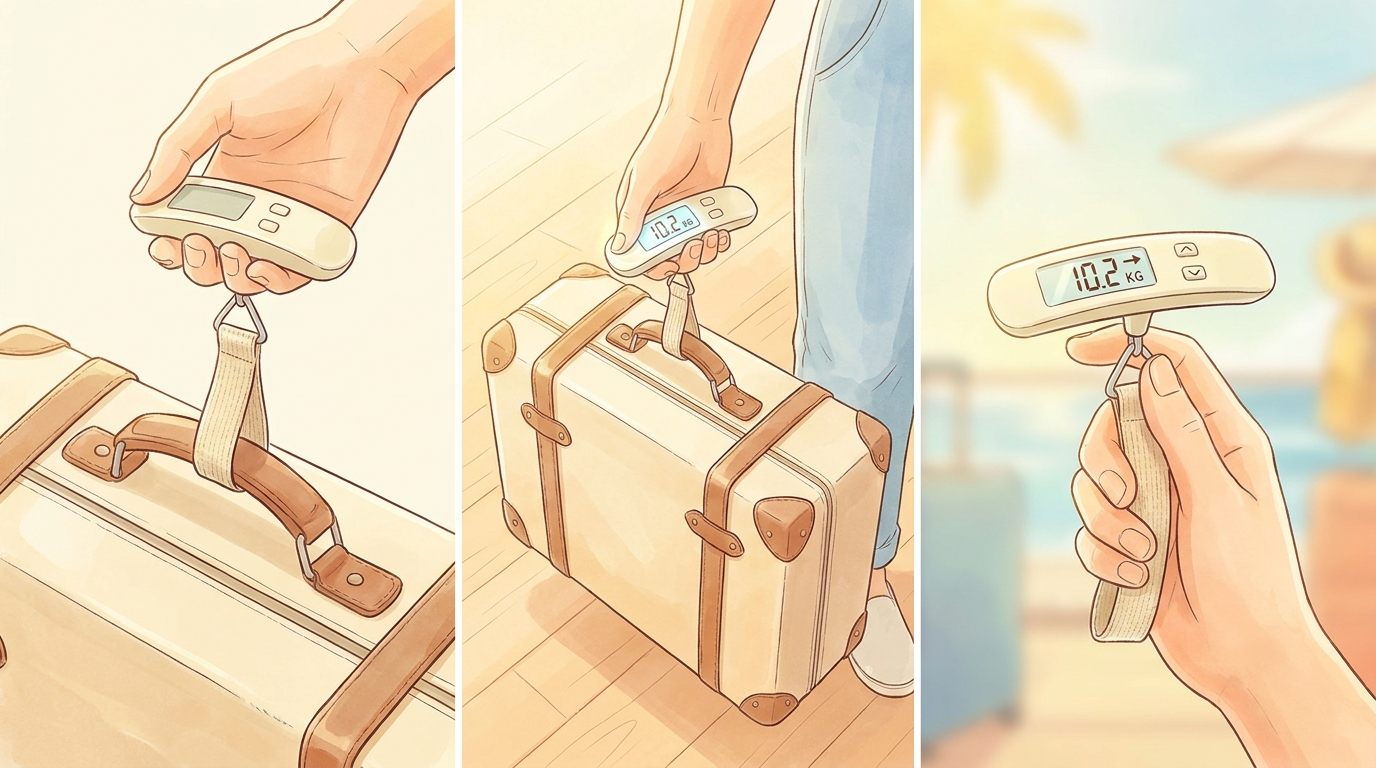
A handheld luggage scale is simple to use, but a few details make the difference between an accurate reading and a nasty surprise:
- Zero the scale first. Turn it on and let it settle before attaching anything, so it starts from zero.
- Attach the strap securely around your suitcase handle, making sure the hook or clip is fully closed.
- Lift smoothly and steadily. Jerky lifting gives false readings. Raise the bag until it hangs completely clear of the floor.
- Hold still and wait for the lock. Most digital scales beep or freeze the display once they have a stable reading — usually a few seconds. Don't read it while the number is still moving.
- Weigh on a hard, level surface, not carpet, and keep the bag from swinging or touching anything.
- Leave a buffer. Aim a kilo under the limit. Airline scales vary slightly, and you may add last-minute items.
One tip that saves a lot of frustration: weigh your bag before you do the final pack of toiletries and shoes, then again at the end. It's much easier to make cuts when you still have things laid out.
What to Look For in a Luggage Scale
Scales are simple devices, but they're not all equal. These are the features that actually matter:
- Sufficient capacity. Look for at least 40–50kg so it handles a fully loaded checked bag without straining or maxing out.
- Accuracy. A reading within about 100g is what you want — precise enough to trust when you're near the limit.
- A clear digital display. Backlit is ideal, so you can read it in a dim hotel room.
- Auto-lock and auto-off. Lock freezes the reading so you can set the bag down before checking it; auto-off saves the battery.
- A sturdy strap or hook. This bears the entire weight of your bag, so build quality here is not optional.
- Genuinely compact and light. The whole point is that it travels with you. If it's bulky, it stays home and does you no good on the return leg.
- Unit switching (kg/lb). Useful if you travel to the US or UK.
Our Digital Luggage Scale
Our scale is built around exactly these priorities.

The Digital Luggage Scale handles weights up to 50kg, which covers any checked bag comfortably, and it's portable and simple enough to use anywhere — at home before you fly, or in a hotel room before the trip back. No more unexpected charges for exceeding luggage limits, and no more redistributing baggage on the spot at the airport.

It's the kind of small, unglamorous item that quietly pays for itself the first time it stops you being over — and then keeps doing so on every trip after that. It slips into a corner of your suitcase and weighs almost nothing itself.
Other Ways to Stay Under the Limit
A scale tells you where you stand. These habits keep you under in the first place:
- Weigh your empty suitcase. Hard-shell cases can be several kilos before you pack a thing — that's allowance you've already spent.
- Wear your heaviest items on the plane. Boots and a jacket can free up meaningful weight.
- Use compression to save space, not add weight. Packing cubes help you fit more in, but remember that weight limits bite before space limits on most airlines.
- Put dense items in your carry-on. Electronics, chargers and books are heavy for their size — shifting them balances your allowance.
- Pack a foldable spare bag. If you're over on the way home, a cabin-sized extra bag is cheaper than excess fees.
- Plan for souvenirs. Leave a few kilos spare on the outbound leg. Our travel packing list helps you pack lean from the start.
Frequently Asked Questions
How accurate are digital luggage scales?
A good digital luggage scale is typically accurate to within around 100 grams, which is more than precise enough for airline limits. Accuracy depends on using it properly — zero the scale first, lift smoothly, and wait for the reading to lock before checking it. Always leave a kilo of buffer, since airline scales can read slightly differently.
What is the baggage weight limit for Australian airlines?
Most Australian carriers allow 7kg for carry-on and 23kg for a standard economy checked bag, though this varies by airline, fare type and route. Jetstar sells checked allowance in weight tiers rather than including it. Always check your specific booking, as international and domestic allowances often differ.
Can I take a luggage scale in my carry-on?
Yes. A handheld digital luggage scale is a small battery-powered device with no restricted components, so it's fine in carry-on or checked luggage. Keeping it in your carry-on is actually the better choice — it means you can weigh your bag on the return trip too.
How do I weigh my luggage without a scale?
The common workaround is to weigh yourself on bathroom scales, then weigh yourself holding the bag and subtract the difference. It works in a pinch but is imprecise — bathroom scales struggle with uneven loads, and the margin of error can easily be a kilo or more. For anything close to the limit, a dedicated luggage scale is far more reliable.
Is a luggage scale worth it?
If you fly even occasionally, yes. A single excess baggage charge at the airport typically costs more than the scale, and airport rates are much higher than pre-purchased allowance. Beyond the money, it removes the stress of not knowing — and saves you unpacking at the counter.
Weigh Once, Travel Calm
Excess baggage fees are entirely avoidable with thirty seconds of preparation. Weigh your bag at home, leave yourself a kilo of buffer, and walk up to the check-in desk knowing exactly what the scale will say. The Digital Luggage Scale handles up to 50kg and packs down small enough to travel with you for the return trip. Browse our full range of travel accessories — every one backed by free shipping and our 30-day money-back guarantee.

Leave a comment
This site is protected by hCaptcha and the hCaptcha Privacy Policy and Terms of Service apply.